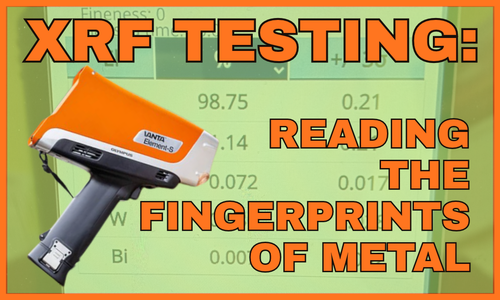
XRF TESTING: READING THE FINGERPRINTS OF METAL
Every metal tells a story.
Sometimes it's obvious. A piece of lead feels heavy the moment you pick it up. A bismuth crystal announces itself with impossible colors and geometric shapes. Tin has a familiar brightness that craftsmen have recognized for generations.
Other metals are far more reserved.
An unlabeled ingot sitting on a shelf may have been purchased last year, or twenty years ago. A casting alloy might be exactly what the previous owner believes it to be. Then again, it might not. Over time, labels disappear, records get lost, and memories become less certain. The metal remains, but the information surrounding it slowly fades away.
That's where XRF testing becomes valuable.
XRF, short for X-Ray Fluorescence, allows us to identify the elemental composition of a material without cutting it apart, drilling into it, or otherwise damaging it. By exposing the surface to X-rays and measuring the energy emitted in response, the analyzer can identify the elements present and estimate their concentrations. In many cases, the process takes only a matter of seconds.
In a sense, every metal has a fingerprint. XRF gives us a way to read it.
One of the most surprising aspects of XRF testing is that it isn't looking very deep beneath the surface. Many people imagine the analyzer somehow scanning the entire piece of metal. The reality is much more nuanced. Depending on the alloy and the elements involved, the effective analysis depth is often measured in micrometers, frequently in the range of just one to five micrometers. To put that into perspective, a human hair is dramatically thicker than the layer being examined.
That limitation isn't a weakness. It's simply part of understanding how the technology works.
If the surface of a metal accurately represents what's underneath, XRF can provide remarkably useful information. If the surface is heavily oxidized, plated, painted, contaminated, or otherwise altered, the instrument will faithfully report what it sees in that outermost layer. Like any analytical tool, the quality of the answer depends on understanding the question.
That's where experience becomes important.
Running an XRF analyzer is straightforward. Interpreting unusual results often requires a deeper understanding of metals, alloys, oxidation, and manufacturing processes. A reading that appears unexpected may point to contamination. It may reveal a coating. Sometimes it raises new questions that weren't apparent when the sample first arrived.
At Rotometals, XRF testing has become an important tool for evaluating unknown materials and helping customers better understand what they have. Sometimes a customer sends in an old ingot with no markings. Sometimes it's a casting alloy acquired at an estate sale. Sometimes it's simply a piece of metal that's been sitting in a workshop for years, waiting for someone to identify it with certainty.
We've made this service available directly through our website so customers can submit samples for analysis. After receiving the material, we perform the XRF testing and provide the results, giving customers valuable insight into the composition of the sample they're working with. In many cases, what begins as a mystery becomes a much clearer picture in only a short amount of time.
The technology itself is fascinating, but the real value lies in confidence.
An XRF analyzer won't reveal every secret a metal contains, and it won't see all the way to the center of a casting. What it can do is provide an extraordinary amount of information about the surface of a material without damaging the sample. Often, that's exactly what's needed to confirm an alloy, identify an unknown metal, or move forward with greater certainty.
If you have an unknown alloy, an unlabeled ingot, or a sample you'd like identified, our XRF Testing Service is available for purchase on the Rotometals website. We'd be happy to help you discover exactly what you're working with.
Every piece of metal has a story.
Sometimes that story stretches back through decades of ownership. Sometimes it's hidden beneath a thin layer of oxide only a few micrometers thick. Either way, XRF testing helps bring that story back to the surface.
To see the listing or place an order, here is the link:
https://www.rotometals.com/metals-analysis-test-xrf-service-test-only-not-the-machine/
Recent Posts
-
XRF TESTING: READING THE FINGERPRINTS OF METAL
Every metal tells a story. Sometimes it's obvious. A piece of lead feels heavy the moment you pick …Oct 20th 2026 -
ROTOMETALS BABBITT ALLOY HANDBOOK: A QUICK ANALYSIS OF EVERY GRADE WE PRODUCE
ROTOMETALS PRODUCES A FULL RANGE OF ASTM‑SPECIFIED BABBITT BEARING ALLOYS, EACH ENGINEERED FOR SPECI …Aug 27th 2026 -
THIS SUMMER'S BIGGEST SELLER: ROTOMETALS' DOWNRIGGER WEIGHTS
Downrigger weights have always been the quiet backbone of serious trolling, the heavy metal that mak …Aug 11th 2026