
FROM ANCIENT SMELTERS TO MODERN MAKERS — THE MAGICAL JOURNEY OF LEAD
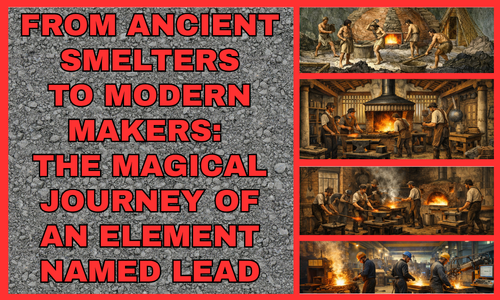
Lead’s story begins in the glow of the world’s earliest furnaces, where ancient craftsmen first discovered a metal that melted easily, shaped willingly, and carried a weight that felt almost supernatural. Around 4000 BCE, in the Near East, a smelter leaning over a clay furnace would have pulled out a silvery, heavy liquid that behaved unlike anything else he knew. He couldn’t have imagined that this same metal would follow humanity through every era that came after, becoming one of the few materials that connects the ancient world to the modern one without interruption. Lead is one of the earliest metals humans ever worked with, and its appeal was immediate: a low melting point that primitive furnaces could reach, a density that made it useful for weights and tools, and a softness that allowed early artisans to cast, carve, and engrave it with ease. Egyptians, Mesopotamians, and Anatolian cultures all adopted lead quickly, using it for everything from seals to vessels to decorative objects. In many ways, lead was the training ground for metallurgy itself. It taught early societies how ores behaved under heat, how to control airflow in a furnace, how molten metal flowed into molds, and how impurities changed the final product. Before copper, bronze, or iron reshaped civilization, lead quietly laid the foundation for the metalworking revolution.
As civilizations advanced, lead remained a constant companion. Nowhere was this more evident than in Rome, which transformed lead from a useful material into an industrial powerhouse. Roman engineers mined and processed lead on a scale the world had never seen, pulling tens of thousands of tons from the earth each year. They used it for water pipes, roofing, coins, cosmetics, writing tablets, and even curse tablets tossed into sacred springs. Their aqueducts, baths, and temples were literally held together by lead, and their empire created one of the first global supply chains dedicated to a single metal. For Rome, lead wasn’t just a resource — it was infrastructure.
What makes lead remarkable is that its usefulness never faded. The same properties that made it valuable to ancient smelters still matter today. Its density makes it unmatched for radiation shielding and counterweights. Its malleability allows it to bend without breaking. Its corrosion resistance lets it survive moisture, chemicals, and time. Its ability to attenuate radiation protects people and equipment in hospitals, labs, and nuclear facilities. Its sound‑dampening qualities make it indispensable in studios and machinery. And its low melting point continues to make it one of the easiest metals to cast and form. Lead isn’t just old — it’s reliable, predictable, and engineered by nature to solve problems that other materials can’t.
In the modern world, lead remains essential across industries that demand performance and consistency. It shields medical imaging rooms, protects nuclear research environments, quiets recording studios, balances elevators and cranes, anchors boats and race vehicles, supports stained glass artisans, and serves as a dependable casting metal for industrial and creative applications alike. Beyond industry, lead still lives in the hands of makers — the stained glass artist shaping came, the sculptor adding weight and structure, the restoration expert preserving historical architecture, the builder creating custom shielding or counterweight solutions. Lead rewards skill. It bends, shapes, and adapts to the person working it, just as it has for thousands of years.
At Rotometals, we see ourselves as part of this long lineage. The principles that guided ancient smelters — purity, consistency, craftsmanship, and reliability — are the same principles that guide our work today. Whether it’s sheet lead for a hospital project, bricks for shielding, or custom alloys for specialized applications, we carry forward a tradition that began long before modern industry existed. Lead is one of the few materials that has traveled with humanity from its earliest fires to its most advanced technologies, and as long as people continue to build, create, and innovate, lead will remain part of the story. We’re proud to help write the next chapter.
Recent Posts
-

ROTOMETALS BABBITT ALLOY HANDBOOK: A QUICK ANALYSIS OF EVERY GRADE WE PRODUCE
ROTOMETALS PRODUCES A FULL RANGE OF ASTM‑SPECIFIED BABBITT BEARING ALLOYS, EACH ENGINEERED FOR SPECI …Aug 27th 2026 -

THIS SUMMER'S BIGGEST SELLER: ROTOMETALS' DOWNRIGGER WEIGHTS
Downrigger weights have always been the quiet backbone of serious trolling, the heavy metal that mak …Aug 11th 2026 -

FROM ANCIENT SMELTERS TO MODERN MAKERS — THE MAGICAL JOURNEY OF LEAD
Lead’s story begins in the glow of the world’s earliest furnaces, where ancient craftsmen first disc …Jun 4th 2026