ROTO BLOG
ROTOMETALS BABBITT ALLOY HANDBOOK: A QUICK ANALYSIS OF EVERY GRADE WE PRODUCE
ROTOMETALS PRODUCES A FULL RANGE OF ASTM‑SPECIFIED BABBITT BEARING ALLOYS, EACH ENGINEERED FOR SPECIFIC LOAD, SPEED, AND SERVICE CONDITIONS. THESE ALLOYS ARE USED IN INDUSTRIAL MACHINERY, MOTORS, COMPRESSORS, SHAFT BEARINGS, AND RESTORATION WORK WHERE PROVEN WHITE METAL PERFORMANCE IS REQUIRED. EVERY ROTOMETALS BABBITT IS MANUFACTURED TO CONSISTENT FORMULAS WITH DOCUMENTED MELTING POINTS, POURING TEMPERATURES, AND METALLURGICAL STRUCTURES THAT MATCH ESTABLISHED INDUSTRY DATA.
ROTOMETALS NUMBER 1
…
Aug 27th 2026

THIS SUMMER'S BIGGEST SELLER: ROTOMETALS' DOWNRIGGER WEIGHTS
Downrigger weights have always been the quiet backbone of serious trolling, the heavy metal that makes deep‑water fishing possible. Long before modern sonar screens lit up boat dashboards, anglers across the Great Lakes and the Pacific Coast were experimenting with crude hunks of lead, trying to force their lures into the cold, oxygen‑rich layers where salmon, lake trout, and other trophy species actually lived. Those early setups were improvised and unpredictable, but they sparked a transformat
…
Aug 11th 2026

FROM ANCIENT SMELTERS TO MODERN MAKERS — THE MAGICAL JOURNEY OF LEAD
Lead’s story begins in the glow of the world’s earliest furnaces, where ancient craftsmen first discovered a metal that melted easily, shaped willingly, and carried a weight that felt almost supernatural. Around 4000 BCE, in the Near East, a smelter leaning over a clay furnace would have pulled out a silvery, heavy liquid that behaved unlike anything else he knew. He couldn’t have imagined that this same metal would follow humanity through every era that came after, becoming on
…
Jun 4th 2026
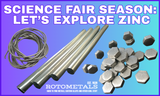
SCIENCE FAIR SEASON: LET'S EXPLORE ZINC
Every year when science fair season arrives, we see the same wave of students, teachers, and parents searching for materials that are safe, predictable, and versatile enough to anchor a project that actually works the way the textbook says it should. Zinc ends up being one of the most valuable metals in that entire ecosystem, and our zinc wire, rods, and sheet stock show up in more exhibits than most people realize because they give students a clean, reliable way to demonstrate real scientific
…
Mar 24th 2026

2026: The Story So Far
Non‑ferrous metals have entered 2026 with a level of volatility and upward momentum that stands out across global commodities. Markets opened the year with copper nearing record highs before pulling back, while aluminum, zinc, and nickel also posted early gains before giving some of them back. This pattern of sharp swings reflects the broader trend analysts are seeing across the sector: non‑ferrous metals are experiencing a historic rally, with some observers calling them the “most dazzlin
…
Feb 26th 2026
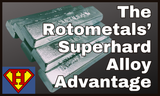
The Rotometals' Superhard Advantage
Superhard alloy has long been one of the quiet workhorses in the casting world and at Rotometals we’ve refined it into a clean, reliable material that gives casters precise control over hardness without the usual frustrations that come with handling raw antimony. Our Superhard ingot, measuring roughly 8‑3/4 inches by 1 inch by 2 inches, is a 30% antimony and 70% lead alloy designed specifically for those who need to strengthen soft lead or wheel‑weight metal without fighting the extreme me
…
Feb 20th 2026
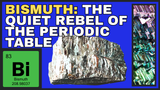
Bismuth: The Quiet Rebel of the Periodic Table
Bismuth has always lived in the margins of the metal world, a shimmering outsider with a personality too strange to ignore and too gentle to fit the stereotypes of heavy metals. For centuries, alchemists misidentified it as tin or lead, unable to reconcile its rainbow‑sheened crystals and low‑melting temperament with the brute force of the metals they knew. Today, Rotometals works with bismuth every day, and the more you handle it, the more you realize it’s a metal that refuses to behave l
…
Feb 10th 2026

Field’s Metal: From Scientific Oddity to Essential Low‑Temp Workhorse
Every alloy has a personality, and Field’s Metal has always been the quiet rebel of the metals world. While most alloys demand roaring furnaces, heavy equipment, and temperatures that turn steel orange, Field’s Metal melts at just 62 °C (144 °F). That’s barely hotter than a cup of coffee. It’s a metal that behaves more like chocolate than like a casting alloy, and that unusual behavior is exactly why it has fascinated chemists, engineers, and hobbyists for more th
…
Feb 4th 2026

The Tin Boom: What Sparked the Sudden Price Jump?
Tin’s sudden price surge has been driven by a collision of tight supply, aggressive investor activity, and rapidly expanding demand from modern technology sectors. Over the past few weeks, the metal has become one of the strongest performers in the industrial commodities market, including a dramatic 12.5% overnight jump that caught even seasoned analysts off guard. Much of this volatility stems from supply constraints in major producing regions such as Indonesia and Myanmar, where export r
…
Jan 22nd 2026

Rotometals Goes Hollywood: Our Hidden Cameo on TV's "Landman"
Rotometals' recently had the thrill of discovering our lead shot was used as ballast weight during the filming of a high‑intensity action sequence. And, as fans of the show, Landman, it was a moment that hit us right in the sweet spot where industry meets entertainment. When you watch a truck explode on screen, the kind of explosion - that lifts the chassis, sends panels spinning, and creates that perfect bloom of fire and debris - it’s easy to assume it’s all chaos. In reality, it&r
…
Jan 15th 2026