The Rotometals' Superhard Advantage
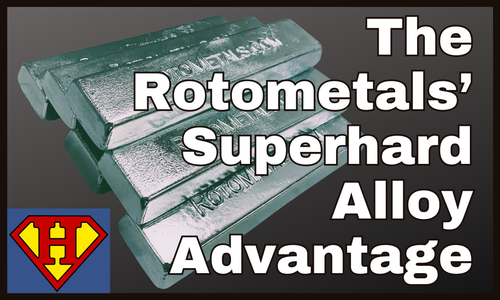
Superhard alloy has long been one of the quiet workhorses in the casting world and at Rotometals we’ve refined it into a clean, reliable material that gives casters precise control over hardness without the usual frustrations that come with handling raw antimony. Our Superhard ingot, measuring roughly 8‑3/4 inches by 1 inch by 2 inches, is a 30% antimony and 70% lead alloy designed specifically for those who need to strengthen soft lead or wheel‑weight metal without fighting the extreme melting temperatures of pure antimony. Because we pre‑alloy the antimony into lead, the ingot melts at around 745°F, a temperature easily reached by most small melting pots, hobby furnaces, and shop‑scale equipment. Instead of dealing with stubborn crystalline antimony that refuses to dissolve, the caster gets a smooth‑melting, predictable alloy that blends cleanly into their base metal.
Antimony is the element responsible for transforming soft lead into something far more capable. It increases hardness, improves mold fill, reduces deformation, and gives cast components the structural integrity they need for demanding applications. Whether someone is casting bullets, counterweights, fishing sinkers, or custom parts, the moment they need their alloy to hold shape under pressure, antimony becomes essential. Rotometals Superhard provides that antimony in a form that behaves consistently and eliminates the guesswork. Because we sell Superhard based on its antimony content rather than its total weight, customers know exactly how much antimony they are adding to their alloy. This makes it easy to build repeatable recipes, match wheel‑weight hardness, or fine‑tune a blend for a specific casting purpose.
One question we hear often is about the Brinell Hardness of Superhard itself. The truth is that the crystalline structure of a 30% antimony alloy makes it extremely difficult to measure accurately with standard hobby‑grade testers. The small ball diameter used in most consumer BHN tools simply cannot read this alloy correctly. A commercial machine with a larger indenter is required to obtain a true value, and because most customers do not have access to that equipment, Rotometals does not publish a hardness number that would inevitably be misleading. Instead, we focus on what matters: consistent composition, clean alloying, and predictable behavior when blended with softer lead.
Superhard has earned its place in workshops because it makes alloy control accessible. Rather than relying on the inconsistent hardness of wheel weights or attempting to melt pure antimony at temperatures that push the limits of small equipment, casters can simply add a measured amount of Rotometals' Superhard and know exactly what they are getting. It is a straightforward, dependable way to move from soft lead to alloys that hold shape, resist deformation, and perform under pressure. For those who want to explore the metallurgy behind antimony‑rich alloys in greater depth, the resource at lasc.us/SuperHard.htm remains one of the most comprehensive explanations available, offering valuable insight into how and why Superhard behaves the way it does.
Recent Posts
-

SCIENCE FAIR SEASON: LET'S EXPLORE ZINC
Every year when science fair season arrives, we see the same wave of students, teachers, and parent …Mar 24th 2026 -

2026: The Story So Far
Non‑ferrous metals have entered 2026 with a level of volatility and upward momentum that stands out …Feb 26th 2026 -
The Rotometals' Superhard Advantage
Superhard alloy has long been one of the quiet workhorses in the casting world and at Rotometals we’ …Feb 20th 2026