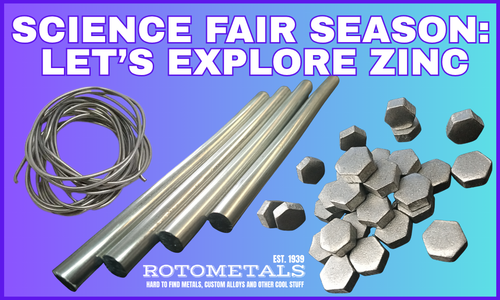
SCIENCE FAIR SEASON: LET'S EXPLORE ZINC
Every year when science fair season arrives, we see the same wave of students, teachers, and parents searching for materials that are safe, predictable, and versatile enough to anchor a project that actually works the way the textbook says it should. Zinc ends up being one of the most valuable metals in that entire ecosystem, and our zinc wire, rods, and sheet stock show up in more exhibits than most people realize because they give students a clean, reliable way to demonstrate real scientific principles without the hazards or unpredictability of other metals. Zinc wire is a staple in electrochemistry projects, where students build galvanic cells, compare metal reactivity, or explore corrosion by pairing zinc with copper, graphite, or aluminum. It bends easily, solders cleanly, and produces consistent voltage outputs, which is why teachers recommend it for everything from simple lemon batteries to multi‑cell power demonstrations. Zinc rod tends to appear in the more mechanical and thermal entries—counterweights for lever and pulley systems, density and buoyancy comparisons, and low‑temperature casting experiments where students want to show phase changes or mold‑making without dealing with the risks of lead or higher‑melting alloys. Because zinc melts at a manageable temperature, it allows students to explore metallurgy in a hands‑on way that feels advanced but stays classroom‑safe. Zinc sheet quietly supports an entirely different set of projects, showing up in conductivity tests, Faraday cage demonstrations, architectural models, shielding experiments, and even environmental science displays where students compare corrosion rates across different metals. It’s soft enough to cut with basic tools yet strong enough to hold shape for engineering builds, which makes it ideal for middle‑schoolers and high‑schoolers alike. What ties all these uses together is that zinc behaves consistently, teaches clean lessons, and doesn’t surprise students halfway through the project. That reliability is why teachers trust it, why parents appreciate it, and why we see the same families returning year after year. Science fairs reward clarity, repeatability, and hands‑on understanding, and zinc delivers all three in a way that helps students focus on the science instead of fighting the material.
Beyond the classic chemistry and physics demonstrations, zinc also finds its way into the more creative and interdisciplinary projects that have become increasingly popular in recent years. Students working on renewable energy displays often use zinc sheet as a grounding or shielding material in small solar setups, or as part of wind‑turbine prototypes where they need a metal that can be shaped without specialized tools. Environmental science projects frequently incorporate zinc wire or sheet in corrosion studies, where students compare how different metals react in saltwater, freshwater, acidic solutions, or outdoor exposure. Because zinc forms a predictable patina, it gives students clear, measurable results that photograph well and translate cleanly into data charts. Even engineering and design students lean on zinc when building architectural models, bridges, or mechanical prototypes, since the metal’s combination of softness and structural integrity lets them create clean bends, folds, and joints without the frustration that comes with stiffer metals. We’ve even seen zinc rods used in kinetic sculptures, magnetic field demonstrations, and thermal conduction experiments where students want a metal that responds quickly to heat without deforming under its own weight. The versatility of zinc means it can support both the straightforward “prove a principle” projects and the more ambitious builds that require a metal capable of doing a little bit of everything.
As science fairs continue to evolve, one thing remains constant: students need materials they can trust. Zinc has earned its place in classrooms and workshops because it behaves the same way every time, whether it’s being used by a first‑time middle‑schooler or a seasoned high‑school competitor aiming for regionals. Our zinc wire, rods, and sheet stock give students the freedom to experiment, test, revise, and build without worrying about hidden hazards or unpredictable reactions. That’s why teachers recommend it, why parents feel comfortable with it, and why we see the same families returning year after year. Science fairs reward clarity, repeatability, and hands‑on understanding, and zinc delivers all three in a way that helps students focus on the science instead of fighting the material. As the season ramps up, we’re always excited to see the creativity and curiosity students bring to their projects, and we’re proud that our zinc products continue to play a role in helping the next generation of scientists, engineers, and makers bring their ideas to life.
Recent Posts
-
SCIENCE FAIR SEASON: LET'S EXPLORE ZINC
Every year when science fair season arrives, we see the same wave of students, teachers, and parent …Mar 24th 2026 -
2026: The Story So Far
Non‑ferrous metals have entered 2026 with a level of volatility and upward momentum that stands out …Feb 26th 2026 -
The Rotometals' Superhard Advantage
Superhard alloy has long been one of the quiet workhorses in the casting world and at Rotometals we’ …Feb 20th 2026