
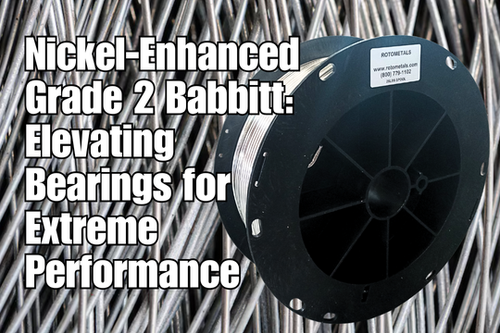
Nickel‑Enhanced Grade 2 Babbitt: Elevating Bearings for Extreme Performance
Grade 2 Babbitt has earned its reputation as one of the most dependable bearing materials in modern industry. Known for its anti‑friction qualities and ability to perform under high speeds and heavy loads, it has long been the go‑to choice for manufacturers who demand reliability. But even proven materials can evolve. By introducing a small percentage of nickel into the alloy, engineers have discovered a way to significantly improve hardness, fatigue strength, and wear resistance. This enhancement transforms Grade 2 Babbitt from a trusted standard into a high‑performance solution for industries where downtime is not an option.
Composition and the Nickel Advantage
Traditional Grade 2 Babbitt is composed of tin, copper, and antimony, creating a matrix that balances low friction with compressive strength and heat resistance. This combination makes it ideal for bearings that must endure constant motion and stress. When nickel is added, however, the alloy’s grain structure becomes more refined. This subtle but powerful change increases hardness, reduces deformation under stress, and strengthens the alloy overall. Nickel also excels in corrosive environments and at elevated temperatures, making it particularly valuable in applications where bearings are exposed to extreme operating conditions.
Performance Benefits in Action
Nickel’s interaction with tin produces unique crystal structures that resist deformation more effectively than tin alone. These structures enhance stability in harsh environments, while the refined grain structure helps prevent cracking and improves fatigue resistance. Bearings made from nickel‑modified Grade 2 Babbitt can withstand repeated stresses without premature failure, making them ideal for high‑stress applications. The alloy also offers a lower coefficient of friction, which reduces wear and improves efficiency in manufacturing environments. Another critical advantage is its resistance to galling—the transfer of material between two metallic surfaces that can cause components to seize. By minimizing galling, nickel‑enhanced Babbitt helps prevent unexpected shutdowns and extends the life of machinery.
Applications Across Aerospace and Energy
The aerospace industry provides a clear example of where nickel‑enhanced Babbitt shines. Turbine engines, which power jets, require bearings that are both lightweight and capable of enduring cyclic loading. Nickel‑modified Grade 2 Babbitt delivers the wear resistance and fatigue strength needed for these demanding applications, ensuring engines remain reliable under extreme conditions. In the energy sector, hydroelectric turbines must operate continuously under heavy loads. Bearings made from nickel‑enhanced Babbitt reduce friction and resist wear, keeping turbines efficient and preventing premature failures. These improvements translate directly into lower maintenance costs and greater operational stability for power producers.
Why Nickel Matters for Modern Industry
While traditional Grade 2 Babbitt remains effective for many standard bearing applications, nickel‑modified formulations offer clear advantages in environments where reliability is non‑negotiable. The improvements in hardness, wear resistance, and fatigue strength make them better suited for industries that demand continuous performance. By reducing friction and preventing machine breakdowns, nickel‑enhanced Babbitt not only improves operational efficiency but also helps manufacturers control costs and avoid production disruptions.
At RotoMetals, we are committed to supplying alloys that meet the evolving needs of modern industry. Our nickel‑enhanced Grade 2 Babbitt is engineered for durability, precision, and performance, supporting applications from aerospace to energy production. To learn more about how our alloys can strengthen your operations, visit www.rotometals.com and connect with our team for expert guidance.
Recent Posts
-

2026: The Story So Far
Non‑ferrous metals have entered 2026 with a level of volatility and upward momentum that stands out …Feb 26th 2026 -

The Rotometals' Superhard Advantage
Superhard alloy has long been one of the quiet workhorses in the casting world and at Rotometals we’ …Feb 20th 2026 -

Bismuth: The Quiet Rebel of the Periodic Table
Bismuth has always lived in the margins of the metal world, a shimmering outsider with a personality …Feb 10th 2026