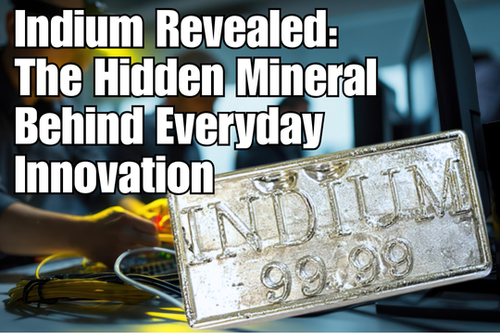
Indium Revealed: The Hidden Mineral Behind Everyday Innovation
Indium is one of those metals that rarely makes headlines, yet its presence is woven into the fabric of modern life. Soft enough to be cut with a knife and able to wet glass and ceramics, it has a melting point of just 313°F (156°C) but remains stable at far higher boiling temperatures. With the symbol In and atomic number 49, indium is classified as a post‑transition metal. It is not mined directly but recovered as a by‑product of zinc ore processing, which makes its availability dependent on other industries. Despite its quiet profile, indium has become a hidden driver of everyday innovation, powering the technologies we rely on most.
The most visible role of indium is in the production of indium tin oxide (ITO), a transparent conductive material that makes touchscreens, flat‑panel displays, and solar cells possible. Without indium, smartphones, tablets, and modern televisions would not function as they do today. Its ability to conduct electricity while remaining optically clear is irreplaceable in these applications. Beyond consumer electronics, indium compounds such as indium phosphide and indium gallium arsenide are critical in high‑speed semiconductors, fiber‑optic communications, and laser diodes. In aerospace and defense, indium alloys are valued for their ability to withstand extreme conditions, while in manufacturing, indium’s unique wetting properties make it indispensable in solders and thermal interface materials.
Yet indium’s importance is matched by its scarcity. Global production is limited, as it is only recovered secondarily, and recycling rates remain low. This fragile supply chain has raised concerns about long‑term availability, especially as demand continues to rise with the growth of consumer electronics and renewable energy. China dominates indium refining, controlling the majority of global output. In recent years, export restrictions and environmental regulations have tightened supply, causing price volatility and raising alarms across industries dependent on indium. Analysts warn that indium could become a choke‑point mineral, where shortages directly impact technological progress.
The strategic value of indium lies in its dual role as both a consumer technology enabler and a defense material. Its presence in everything from smartphones to satellite systems means that supply disruptions ripple across both civilian and military sectors. As nations push toward renewable energy and advanced communications, indium’s role will only grow. This has prompted governments and manufacturers to explore alternative sources, improve recycling technologies, and secure long‑term contracts to mitigate risk.
Indium’s story is a reminder that even the softest metals can carry immense weight in shaping the future. Its unique properties make it irreplaceable in modern electronics, while its scarcity underscores the importance of strategic planning in global supply chains. For manufacturers, the challenge is not just about harnessing indium’s capabilities but ensuring reliable access in a world where supply is anything but guaranteed.
At RotoMetals, we understand the critical role of specialty metals like indium. By staying ahead of global supply trends and offering materials engineered for performance and reliability, we help customers navigate uncertainty while unlocking new opportunities. To learn more about indium and other strategic metals, visit www.rotometals.com.
Recent Posts
-
2026: The Story So Far
Non‑ferrous metals have entered 2026 with a level of volatility and upward momentum that stands out …Feb 26th 2026 -
The Rotometals' Superhard Advantage
Superhard alloy has long been one of the quiet workhorses in the casting world and at Rotometals we’ …Feb 20th 2026 -
Bismuth: The Quiet Rebel of the Periodic Table
Bismuth has always lived in the margins of the metal world, a shimmering outsider with a personality …Feb 10th 2026