
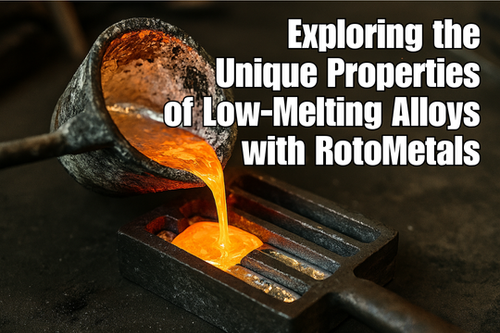
Exploring the Unique Properties of Low‑Melting Alloys with RotoMetals
Low‑melting alloys are essential across a wide range of industries, from soldering delicate components to bending pipes cleanly around corners, and even securing optical lenses during grinding. Their ability to be processed at lower temperatures makes them particularly valuable when working with materials that could be damaged or react negatively to higher heat. By enabling manufacturing and casting at reduced temperatures, these alloys open the door to safer, more efficient production methods.
These alloys are generally divided into two categories: eutectic and non‑eutectic. Eutectic alloys melt sharply at a single temperature, typically between 117°F and 281°F, transitioning instantly into a liquid state. Non‑eutectic alloys, on the other hand, melt over a broader range of 107°F to 338°F, first forming a semi‑liquid slurry before becoming fully molten. Both types are formulated from combinations of metals such as bismuth, tin, indium, lead, cadmium, and antimony, with each blend engineered to deliver specific performance characteristics depending on the application.
One of the most important properties of certain low‑melting alloys is their bendability. These alloys are used when tubes or other metal parts must be shaped without cracking, kinking, or deforming. Because they expand slightly upon solidification, they help maintain the integrity of the material during rolling or extrusion processes. Bismuth‑based eutectic alloys, such as Bend and Base alloys, are especially popular for these applications, offering reliable performance in forming operations.
Stability is another critical factor. Alloys containing bismuth, tin, and lead with indium added can achieve extremely low melting points, ranging from 117°F to 138°F. They cast cleanly with minimal shrinkage or expansion, making them ideal for precision holding tasks. Lens alloys, for example, are used to secure optical lenses, glasses, and plastic lenses during surface grinding. After use, these alloys can be recovered and recycled, reducing waste and cost. Other stable alloys, such as TRU alloy, which melts at 281°F, are widely used to hold jet engine blades during machining, where dimensional reliability is essential.
Shrinkage and growth behavior also play a role in alloy selection. Some alloys are designed to remain dimensionally stable during solidification, while others intentionally shrink and then expand back to their original size—or beyond. Non‑eutectic Safe alloy and eutectic Mellottes alloy are examples used in proof casting. Their shrinkage during solidification allows easy removal from molds before expansion occurs, making them excellent for temporary casting and testing applications.
Choosing the right alloy requires careful consideration of how it behaves during melting and solidification. Engineers must evaluate whether they need an alloy that holds parts securely in place, bends tubes without damage, performs soldering at low temperatures, or shrinks for easy mold removal. With its wide range of customizable formulations, RotoMetals provides alloys that meet these diverse requirements, ensuring consistent quality and dependable performance across applications.
RotoMetals is proud to supply low‑melting alloys that support industries from optics to aerospace. To learn more about how these alloys can benefit your next project, visit www.rotometals.com.
Recent Posts
-

2026: The Story So Far
Non‑ferrous metals have entered 2026 with a level of volatility and upward momentum that stands out …Feb 26th 2026 -
The Rotometals' Superhard Advantage
Superhard alloy has long been one of the quiet workhorses in the casting world and at Rotometals we’ …Feb 20th 2026 -

Bismuth: The Quiet Rebel of the Periodic Table
Bismuth has always lived in the margins of the metal world, a shimmering outsider with a personality …Feb 10th 2026